Wednesday, 13 October 2010

EBC trek: Day 4 - Namche to Pangboche

Today we trekked up to Tengboche Monastery then onto Pangboche to spend the night at 3900m. It was a long day – six hours of trekking and some long tough climbs too. During the morning and early afternoon, the sun was very strong, and I think this caused the headache I had that afternoon. Still after some paracetamol it had gone by dinner.


Most of the villages we passed grow potatoes, so unsurprisingly these are forming a staple of my diet (which makes a nice change from rice!). In addition to daal bhat, I have been eating a lot of potatoes and eggs. Chhatra informs us that because everyone in the mountains are Buddhist, they are not allowed to kill animals (although they will mostly happily eat them once dead!). This means the meat available has been killed a few days below Lukla, and carried up on the back of porters – for this reason, I will be vegetarian for the trek (hence all the eggs for protein)!


We saw the Australian, George (who Chhatra knew from a past trek and whom we met at Kathmandu airport) and his group again today. He is finding it tough because of arthritic back pain and a possible ear infection, but remains positive and determined as ever!

In the evening we met some climbers from Georgia which had turned back after camp 3 on nearby Ama Dablem mountain – quite disappointing for them. and their mood reflected this.

EBC trek: Day 3 - Kumjung and Khunde

We are staying in Namche again tonight to help acclimatise, but went on a five hour trek around the surrounding villages.

We walked up to Kumjung and neighbouring Khunde (3800m), nestled in a valley overlooked by Mount Everest and surrounding mountains.


Kumjung is home to a very old monastery, which although lavished with paintings and lots of religious texts, is perhaps best known amongst trekkers for being home to the supposed only Yeti scalp! After a small donation, we were shown this artefact, which is said to be 500 years old.  The rest of the village consists of green tin-roofed houses with small plots of land, divided by dry-stone walls much like in some national parks back home, except they squash yak dung on the walls to dry in the sun before it can be burned as fuel! The small allotments allow the Sherpa people to grow crops, notably potatoes.

Khunde is home to a hospital, founded by Sir Edmund Hillary in 1966. It is staffed by a doctor, nurse and a few healthcare workers who care for approximately 7000 people from the surrounding villages as far away as Phakding (which we passed on the first day). They also treat foreigners with acute mountain sickness or other ailments. The doctor on duty showed us around the well-equipped hospital, which was also much cleaner than Kanti! It would have been a nice add-on to spend a week there after the rest of the elective in Kathmandu, and I would certainly recommend this to other students thinking of spending their elective in Nepal.

In addition to founding the hospital, Sir Hillary also founded a school in Khunde, and after his death in 2008, the local people showed their appreciation of his dedication to Sherpa welfare by erecting a memorial stupa in their village.

Before heading back to Namche, we went up to Everest View Hotel for a cup of tea – at 3900m, it is the highest 5-star hotel in the world.


EBC trek: Day 2 - Benkar to Namche

Having descended on the first day to sleep at lower altitude, today saw us climb to 3440m – Namche Bazaar (‘Nam-chay’). This is a thriving market town, where the trade routes from Tibet meet Nepal. The altitude is becoming noticeable now – I think I am higher than I have ever been (before was Cusco, Peru at 3400m), and Chhatra reminds us of the need to keep drinking lots of fluids (about 3L/day) because of the amount lost through breathing.

The walk up was hard and at one stage Yan was regretting us not using porters! The journey followed the Dudh Kohsi (‘milky river’) and up through the sweetly scented pine forests. We crossed the river five times today, on precarious but Swiss-built suspension bridges. This is certainly not suitable for those with a fear of heights – as we walked along 50m about the river, I couldn’t help but look down and ponder whether if I fell I would die of trauma, downing or hypothermia first!

In the afternoon after we arrived in Namche, we went to a bar showing Touching the Void – a film about two mountaineers in Peru who almost die in the quest for the summit!

It’s hard to keep drinking enough, as I don’t really feel thirsty, but during the night I awoke three times with a very dry mouth. It’s a bit of a juggling match between keeping your mouth dry and not needing to get out of the warm sleeping bag to go to the less than desirable squat toilet!

EBC trek: Day 1 - Lukla to Benkar

I left for the airport in Kathmandu early in the morning, and eventually arrived at Tenzing & Hillary Airport in Lukla around 11am. The first thing I noticed is that it is a lot cooler at 2800m. Although a t-shirt was still sufficient, the crisp air was a welcome break from the humid intensity of Kathmandu. After a late breakfast in Lukla, we started the walk down to Benkar to spend the night at the lightly lower 2600m.

Lukla Airport
During the 3 hour walk, we passed many waterfalls, crossed rivers and admired the scenery. The river water was beautiful and clear, descending from the mountains high above. It also was so intense it made the white water rafting we did a few weeks ago look positively tame!


One of the nice things about trekking is how friendly everyone is (much like hiking in the British countryside). Chhatra is always stopping to greet other guides he knows – which as he has done the trek about 200 times before is a lot of them – and other westerners always say hello. Just today I have met Jerome (‘Yar-roon’) from the Netherlands, a couple of doctors from the USA, and a Spanish couple who stayed at the same lodge. I started the trek as I meant to go on – a dinner of traditional Nepali daal bhat followed by bed at 8pm!


Friday, 1 October 2010

Everest base camp trek

I've bought my iodine, high energy snacks, toilet paper (nothing is provided!), and a bag of 'maoam' sweets in case I need a psychological boost, and hired a down sleeping bag that goes down to -20C, so I think I'm ready to go!

We leave tomorrow, flying to Lukla, then on from there. Should reach base camp by Monday week, and back to Kathmandu the Friday after (it's much easier coming down as you don't have to stop to acclimatise to the altitude). There won't be any chances for me to update until I get back, but I really looking forward to it!

Thursday, 30 September 2010

Indra Jata II

The festival continued this week, and on Monday night I was invited to Dr Yogendra's father's house, which overlooks the street where the procession was due to pass.

I arrived in time for traditional food of beaten rice (literally squashed, uncooked rice), various curried meats and potato, some sweet foods (such as the ball which looks like marzipan but is like a sponge full of milk - I think I mentioned it before - and a sticky waffle-like food), and some very strong rice wine (much stronger than Japanese sake).


It was great to really feel part of the festival - first we saw some people dressed as gods pass the street, dancing causing lots of shouting and chanting, then there was the elephant (like a pantomime horse) which stopped at various doorways to receive blessings, then finally the part everyone was waiting for - the three chariots. Of course I saw all of these of course in the festival in Durbar Square before, but this was quite different as there was not nearly as many people, and in my position in the first or second floor window (and I also went down to the street a couple of times) you could see the whole spectacle much more clearly. The chariots where perhaps a little too big for the fairly narrow streets, and pulled by long tug-of-war style ropes each pulled by a dozens or so enthusiastic men. I didn't envy the people with the job of steering, as they lurched from one side to the other, almost taking out people lining both sides, and also damaging some banners and telephone wires crossing the street due to their height.


It was a great experience, and I have some photos as well as video which I will upload when I get to somewhere with a faster internet connection!


On a different note, forget the Aktins diet! If you really want to loose weight, I would thoroughly recommend a long trip to Nepal. I can guarantee 6 weeks of humidity, variable food, 'Delhi belly' and trekking will cause you to start shedding the pounds! I was just recovering from giardiasis, but the tinidazole seems to have worked, but now I have a cold too. Still, Everest? Bring it on!

Monday, 27 September 2010

Pokera

This weekend we visited the city of Pokera. It is about 200km West of Kathmandu, and sits at lower altitude (and so was even warmer!)

We left in the afternoon after hospital, taking a minibus ('microbus' here) for the six hour journey through the very beautiful winding countryside, passing the Royal Beach resort where we went rafting etc on the way.

View from Hotel balcony (Lake to the left of shot). The pointy mountain is called Machapuchre. At 6997m tall, it is the only mountain in Nepal which is forbidden to be climbed


The hotel recommended Hotel ABC, which was situated in the popular Lakeside area of Pokera, so called because of it's positioning adjacent to the tranquil Prewa Tal lake. Hari, the hotel manager met us at the bus stop, and recommended the Almond Restaurant for 'the best food in Pokera'. I have to say that I was not disappointed! My ‘Almond Special Butter Chicken’ curry was delicious – very creamy tomato flavour, mild but much nicer than the standard korma in the UK! After finishing off with butter scotch ice cream, I felt a lot better after our long and bumpy journey.


Walking up Sarangkot


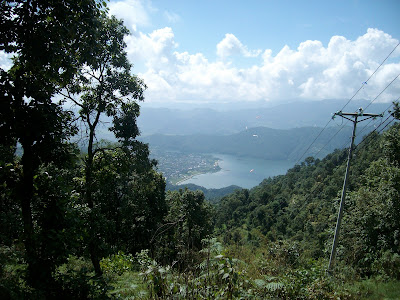
On Saturday I hired a motorbike and Yan a moped and we set off to Sarangkot. This village is on top of one of the hills surrounding the lake, and offers spectacular views of the Annapurna part of the Himalaya. I walked the final half an hour up to the top, and despite the cloud covering most of the mountains (much like in Nagarkot), you could still see very far:

View from the top over Prewa Tal

 After Sarangkot, we rode around for a while before visiting the Gurkha Memorial Museum. It is situated in Pokera because of the nearby recruiting base, which still attracts hundreds of applicants for the honour of being accepted as Gurkha soldier in the British Army.


The museum is filled with memorabilia and history dating back from the days of the East India Company to the present day. The most moving contents however, are the tales of dozens of men filling the walls, most accounts record episodes of great bravery for which they were honoured, often with a VC.


The Khukuri knife, a symbol of the Gurkhas

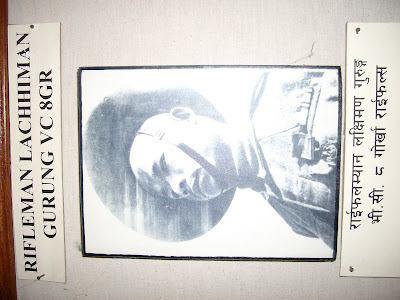
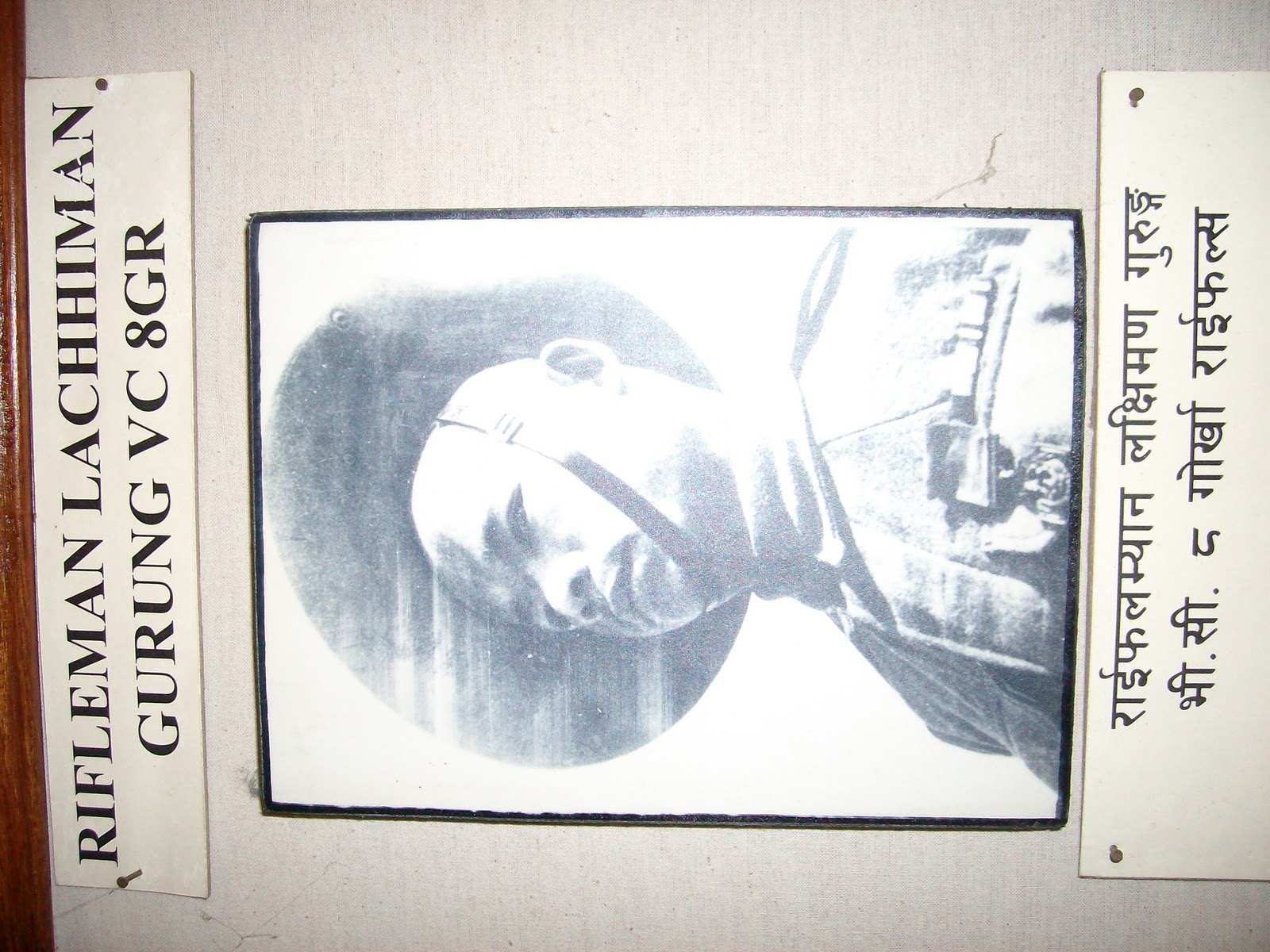
One such account is that of Rifleman Lachhiman Gurung (above), who in 1945 whilst fighting the Japanese hurled back a grenade which fell on the edge of his trench, then immediately afterwards threw back another which landed inside the trench. When the third grenade landed just in front of him, he once again attempted to throw it back but it exploded in his hand, and he lost his fingers and was bleeding severely. With two comrades wounded in the bottom of the trench, he switched his rifle to his left hand, and maintained a steady rate of fire for over four hours as wave after wave of Japs attempted to storm his trench, which was essential for the battle. Of the 87 enemy dead, 31 lay in front of this man’s post. He was evacuated to hospital, but lost his right arm and eye. He was awarded the Victoria Cross in Delhi, and his proud elderly father was carried for 11 days by members of his village to be there. One of his sons is now an officer with the Gurkha Rifles.


There are many other stories of equal bravery and dedication, and the museum was a fitting tribute to the many Gurkhas who have fought and continue to fight for the British Army.


On Sunday we got a boat ride across the lake, and then walked half an hour up to the World Peace Pagoda (on a hill the opposite side of the lake to Sarangkot). I was very hot and had sweat dripping from my face by the time we got to the top, but it was worth it from the top. Photos to follow.